Holographic Art: Future Painting Techniques Guide
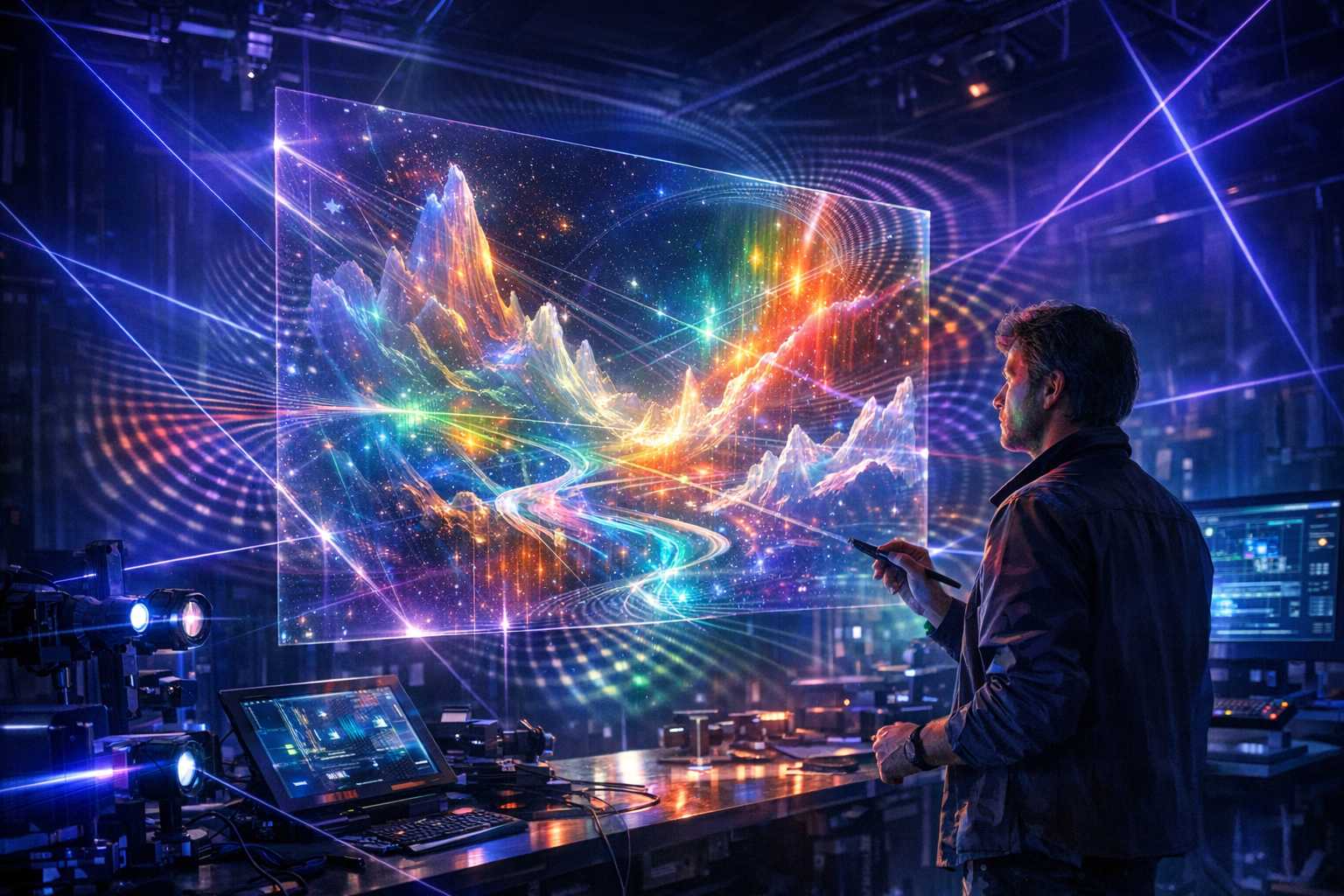
Exploring the Future of Art: Guide to Holographic Painting Techniques
Ever come across a painting that appears to alter and shift as you change your viewing angle? Welcome to the remarkable realm of holographic art - an innovative form of art expression that is redefining our understanding of conventional painting.
Understanding Holographic Art
Holographic art produces three-dimensional imagery that seemingly floats in open space. Unlike ordinary paintings, these artworks provide a dynamic viewing experience as they alter when you move around them.
This type of art makes use of light interference patterns to capture and display visual data. When looking at a completed piece, viewers can see different perspectives, much like having numerous paintings in one, depending on their viewing angle.
Fundamental Techniques in Holographic Art
Laser-based Recording
This conventional technique uses laser light to take images. The artist uses particular tools to record light designs on photosensitive materials. This method requires precise timing and a steady hand.
The process involves using laser sources, mirrors, and recording plates. Each component must be impeccably positioned. Even the slightest of vibrations can ruin the entire artwork.
Digital Holography Techniques
Contemporary artists now make use of computer-generated techniques to create holographic art. These digital techniques offer a greater creative space and the ability to form impossible scenes that can only be achieved through imagination.
Specialized software allows artists to fashion intricate 3D models which are then utilized to create holographic displays. The end results can be simply spectacular.
Essential Equipment for Creating Holographic Art
Traditional Setup Needs
Creating holographic art using lasers necessitates having a table that is completely free of vibrations. Systems designed to prevent movement during the recording process and specific lighting controls to maintain a stable environment are also vital
The lasers used need to generate coherent light beams, photographic plates are used to capture the interference patterns, and special chemicals are employed to develop the final imagery.
Modern Digital Tools
The advancements in computer hardware have made the creation of holographic art more accessible. High-powered processors are used to handle complex computations, and graphics cards to quickly render intricate 3D scenes.
There are specialized software programs designed to create holographic files. These programs cater to different levels of computer literacy, with some offering user-friendly interfaces perfect for beginners while others are equipped with professional-grade tools for experts.
Popular Holograph Styles
Abstract Light-Sculptures
Numerous artists venture into creating abstract forms shifting in flowing elegance. These pieces underscore color and movement over realism. The final results often resemble suspended beams of light mid-dance.
Viewers may experience various emotions from different angles. The same art piece may evoke calmness from one side while seeming energetic from another.
Realistic Holographic Portraits
Some artists focus on creating portraits that bear an uncanny resemblance to real human subjects. These portraits are incredibly detailed and profound in depth, often giving the illusion that one is looking at actual individuals frozen in time.
The amount of technical skill required for this level of realism is substantial, with each facial detail needing to be flawlessly captured in three dimensions.
Interactive Environmental Scenes
Skilled holographic artists can create entire worlds. Whether these are landscapes, cityscapes, fantasy realms, or other environments, viewers can feel as though they are being transported to different places and times.
These complex pieces often narrate a tale, with new details and narrative progressions being revealed as one explores the scene from different angles.
A Step-by-Step Process to Creating Holographic Art
Planning Your Artwork
Begin with meticulous sketches and concept ideas. Factor in how the artwork will appear from various angles. Lighting and composition should be meticulously planned.
Consider the location of your viewers and how they’ll navigate the artwork. These aspects will influence your design choices.
The Recording or Rendering Stage
The traditional technique demands careful alignment of lasers. Each beam should perfectly hit the recording surface. The exposure duration will govern the quality and brightness of the image.
Digital artists start with 3D modeling software to construct virtual scenes complete with textures, lighting, and movements. Rendering can take anywhere from a couple of hours to a few days, particularly for more intricate pieces.
Post-Production and Displaying Your Art
Developed holograms require a particular setup involving mounting and lighting. Display cases are often used to sustain the artwork's delicate surfaces, with unique illumination used to accentuate its three-dimensional attributes.
Digital hologram displays require projection equipment, usually consisting of LED arrays or laser projectors. Proper calibration guarantees an accurate color exhibition.
Current Uses and Applications of Holographic Art
Art Galleries and Museums
Many cultural organizations now orchestrate holographic exhibitions. These exhibits attract viewers interested in the new and unique experiences offered by this format. The interaction between the viewer and the art piece often leads to unforgettable experiences.
Curators value holograms for their ability to protect delicate artifacts. Viewers are able to examine historical objects from all angles without causing any risk to the original piece.
Commercial and Advertising Purposes
Companies are increasingly using holographic displays for marketing purposes. Product demonstrations become far more engaging and memorable, and customers tend to spend more time engaging with holographic presentations.
Holographic art also serves retail environments well, with eye-catching displays drawing potential customers into stores and generating buzz on social media platforms.
Educational Usage
Educational establishments make use of holograms for teaching purposes. Concepts that are challenging to grasp are easier to understand when portrayed three-dimensionally. Students can study molecular structures or artifacts in close detail.
Medical schools find holography particularly beneficial, with prospective doctors given the chance to examine organ systems from every conceivable angle.
The Future of Holographic Art
Upcoming Technologies
Artificial Intelligence (AI) has started to influence the creation of holographs. AI algorithms, for example, can autonomously generate intricate 3D scenes. Such technology could potentially make creating holographic art universally accessible.
The integration of Augmented Reality (AR) is another promising development. Artists may soon be able to create holograms that can interact with real-world environments, leading to a further blurring of the lines between physical and digital art.
Improved Accessibility
The cost of the necessary equipment to create holographs gradually continues to decrease, placing the technology within the reach of more artists. Furthermore, educational establishments are incorporating holographic programs into their courses.
Software designed to be user-friendly is making the learning process smoother. Novices can now create straightforward holograms without needing vast technical knowledge. Moreover, resources like online tutorials and communities offer support and inspiration.
Predicting Market Growth
Experts anticipate speedy growth in the market for holographic art. Art collectors are increasingly investing in these distinctive pieces, and the number of galleries representing holographic artists is on the rise.
Commercial uses of holographs are spurring the development of better technology, which, in turn, benefits artistic applications. This reciprocal relationship paves the way for innovation in both domains.
Starting Your Journey into Holographic Art
Learning Resources
You can find online courses that teach essential techniques. Video tutorials offer step-by-step guidance, and online forums connect beginners with highly experienced artists.
Resource materials like books and scholarly papers provide the theoretical foundation to gaining a comprehensive understanding of the subject which aids artists in pushing their creative limits. Libraries often possess extensive collections on holography.
Recommendations on Practice
Starting small, with simple subjects, before progressing to attempt more intricate scenes is recommended. Get a solid understanding of the basic techniques before moving on to more complex work. Remember, consistency and patience are key for success in this medium.
Consider joining local art clubs or connect with online communities. Sharing your work and getting feedback can fast-track your learning process. Collaborations often lead to surprising discoveries.
Investment Considerations
Prioritize investing in quality equipment from the start. Lower-quality tools often fail to deliver the desired results. Consider renting pricey equipment before committing to a purchase.
Also, take into account ongoing costs such as materials and software updates. You may also need to invest in professional development opportunities such as workshops and courses to further hone your skills. These expenses are an integral part of your artistic growth process.
Holographic art presents an exciting development in the realm of visual expression. As the technology further evolves and becomes more accessible, it's likely we'll witness a significant expansion in this field. Regardless of whether you're an artist, a collector, or simply intrigued by novel art forms, holographic art offers limitless possibilities for creative exploration.
The future of painting isn't confined to brushes and canvas. It now encompasses light, space, and the magic of three-dimensional storytelling. Are you prepared to step into this incredible new reality?