Interior Light: Impressionist Room Painting Techniques
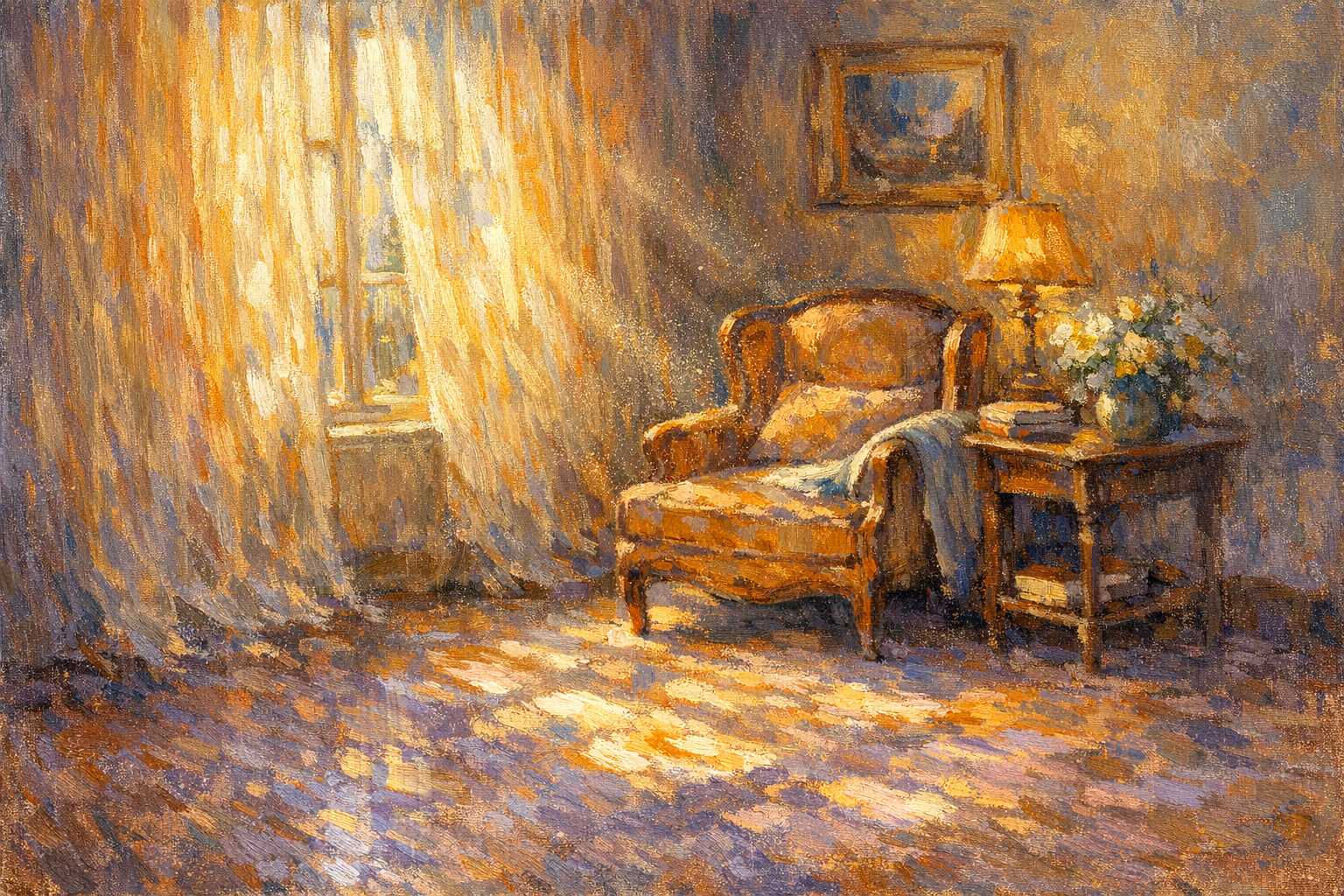
Capturing Interior Glimmers: Techniques in Impressionist Room Painting
Have you ever been captivated by the way sunlight creates a spectacle as it darts across the room's interior? For centuries, artists have been enchanted by this lively interplay of light and shadow. In this article, we delve into the art of capturing this magical quality through the use of techniques inspired by impressionist room painting.
The Heart of Impressionist Lighting Philosophy
Impressionist painters significantly altered our perception of interior spaces. Their art was not limited to a representation of what they saw - instead, they painted the feelings evoked by light.
For instance, Claude Monet expressed his desire to be born blind and then have his sight restored. He yearned to paint uninfluenced by object recognition, capturing instead the essence of pure light and color.
Impressionists introduced the concept that shadows are not merely shades of grey or black. Instead, they are imbued with colors reflected off near objects. So, depending on the surroundings, a white wall could appear purple in the shadows, subtly reflecting hues from a proximal blue curtain.
Core Color Theory for Interior Light
Collaborating with the Natural Color Temperature
The cool and crisp essence of morning light, laden with blue undertones, conjures up an air of freshness and cleanliness.
As the day progresses, afternoon light takes a warmer tone, inundating rooms with inviting golden yellows and oranges.
When evening sets in, the light dramatically transforms to rich oranges and reds, draping everything in cozy, intimate hues.
Mixing Colors for Realistic Shadows
Instead of relying on black paint for crafting shadows, consider the fact that real shadows are infused with light reflected from surrounding surfaces.
In this context, try the technique of mixing complementary colors. A shadow cast by a yellow wall might benefit from a purple infusion, while a red sofa's shadow could gain depth with some added green undertones.
Enrich your shadow mixtures with the local color of objects around them. This approach brings a sense of realism and harmony into your artwork.
Brushwork Techniques for Capturing Light
The Broken Color Method
Resist the urge to blend all colors smoothly on your canvas. Rather, place small strokes of distinct colors in proximity to each other.
From a distance, your eye will merge these colors, fostering an energy and vibratory effect that lone color blocks can't replicate.
Primarily use this technique in areas where light meets surfaces, letting the broken color method visually replicate the shimmer and dance of light.
Directional Brushstrokes
Your brushstrokes should mirror the direction of the light source in your artwork. So, if sunlight streams diagonally across a room, mimic it with diagonal strokes of your brush.
Vertical strokes are well-suited for walls bathed in direct overhead light, while horizontal strokes complement surfaces lit from the side.
Following the light's path in your brushwork guides the viewer's eye through the painted scene.
Delineation of Different Light Sources
Nature’s Window Light
Position yourself to observe the evolving light throughout the day. Morning light casts long, dramatic shadows.
Around noon, the light tends to appear harsh, casting sharp contrasts, before transforming into a warm, golden hue in the late afternoon.
Experiment with painting the same room at varying times and witness the profound effect light has on the room's overall mood.
Artificial Interior Lighting
The warmth of lamp light casts intimate circles, with quick falls into darkness, emphasizing dramatic contrasts.
Overhead lighting, while less alluring, provides an even illumination and may be simpler for beginners to interpret.
Candlelight, with its tantalizing flicker and shifting shadows, provides the most captivating yet challenging light source to replicate.
Cultivating Mood Through Light and Color
Warm Light for Comforting Environments
To create welcoming spaces that beckon viewers to relax, incorporate hues of warm whites, oranges, and yellows. A few red touches in areas illuminated the most emulates the comforting glow of a fireplace or sunset.
In scenes lit warmly, ensure your cool colors remain muted, letting the warm shades reign supreme for added emotional value.
Cool Light for Crisp, Contemporary Vibe
Employ cool grays, blues, and crisp whites in your palette to evoke modern, clean atmospheres - perfect for contemporary interiors.
Hint at subtle lavenders and cool greens in your shadowy regions, adding an airy lightness, and sparingly use warm accents to highlight a room's focal point.
Handy Tips for Painting Interior Scenes
Arranging Your Workspace
Commit to a consistent painting time daily, as varying light conditions could distort color matching.
Craft a homemade viewfinder from a piece of cardboard and use it to frame your composition, simulating a camera's perspective.
Photographs are useful as references but shouldn't replace your own observations. Cameras often fail to capture the minute color interactions visible to the human eye.
Initiation of Your Painting Journey
Begin by defining your largest light and shadow shapes. Squinting simplifies your view into basic value sketches.
Establish your lightest light and darkest dark early on, with everything else falling in between these two extremes.
Adopt a general-to-specific approach, encapsulating the overarching light pattern before introducing finer details.
Common Blunders to Steer Clear Of
Avoid over-brightening your artwork. Limit the use of your purest, brightest colors to your dominant light source.
Resist the temptation to paint objects in isolation. Each object influences others with its color and light.
Refrain from overworking your paint. Confident strokes render light more effectively than overblended or muddy segments.
Learning from the Pioneers
Taking Inspiration from Vermeer’s Window Light
Study Johannes Vermeer's execution of transitioning from light to shadow in scenes illuminated by soft, natural window light.
His use of cool shades in shadow regions and warmer hues in well-lit areas paints a vivid illusion of natural daylight.
His paintings emphasise that simplicity can often trump complexity, as straightforward compositions bathed in gorgeous light evoke profound emotional resonance.
Taking a Page from Monet's Series Paintings
Monet dedicated a series of his work to the study of changing light by focusing on common subjects. His series featuring haystacks and cathedrals are prime examples.
Try emulating Monet by painting the same corner of a room during different periods of the day, which will provide real-time lessons about light that no book can rival.
Note how Monet's later works exhibit bolder colors, demonstrating his departure from realism in favor of emotional impact.
Advanced Techniques for Light Effects
Capturing Reflected Light
Light reflected off surfaces often illuminates other areas indirectly. For instance, a white ceiling can bounce light onto the furniture below.
Colored surfaces often impart their hues to their reflected light. Notably, a red wall emits subtle red reflections on proximal white objects.
Pay close attention to these modest color influences since they play a crucial role in aspiring for utmost realism and sheer luminosity in your paintings.
Depicting Atmospheric Perspective Indoors
Similar to outdoor settings, objects in the distance appear cooler and less contrasted even within rooms. Thus, a wall far away may appear grayer compared with objects in the foreground.
Small airborne dust particles blur distant details, so backgrounds should be painted with less defined edges and toned-down colors to add depth and realism to your interior scenes.
Closing Thoughts
Mastering the impressionist room painting techniques is a journey requiring constant practice and acute observation. As a starting point, observe the changing light in your own home closely.
Note the heated hues of the sunrise, the shifting shadows throughout the day, and how they bounce off surfaces to subtly influence colors around them.
Remember, when painting light, you are painting relationships. Color contrasts depend heavily on their surroundings.
But above all, prioritize personal emotions and self-expression over precision. The impressionist artists aimed to record sentiments, teaching us that the essence of an artwork lies not just in what you see but also what you feel.
With consistent practice and patience, you'll soon be able to infuse your paintings with life-like qualities, making them glow with an authentic warmth that mirrors that of the art produced by the impressionist masters.