Coastal Scene Painting: Impressionist Seascape Guide
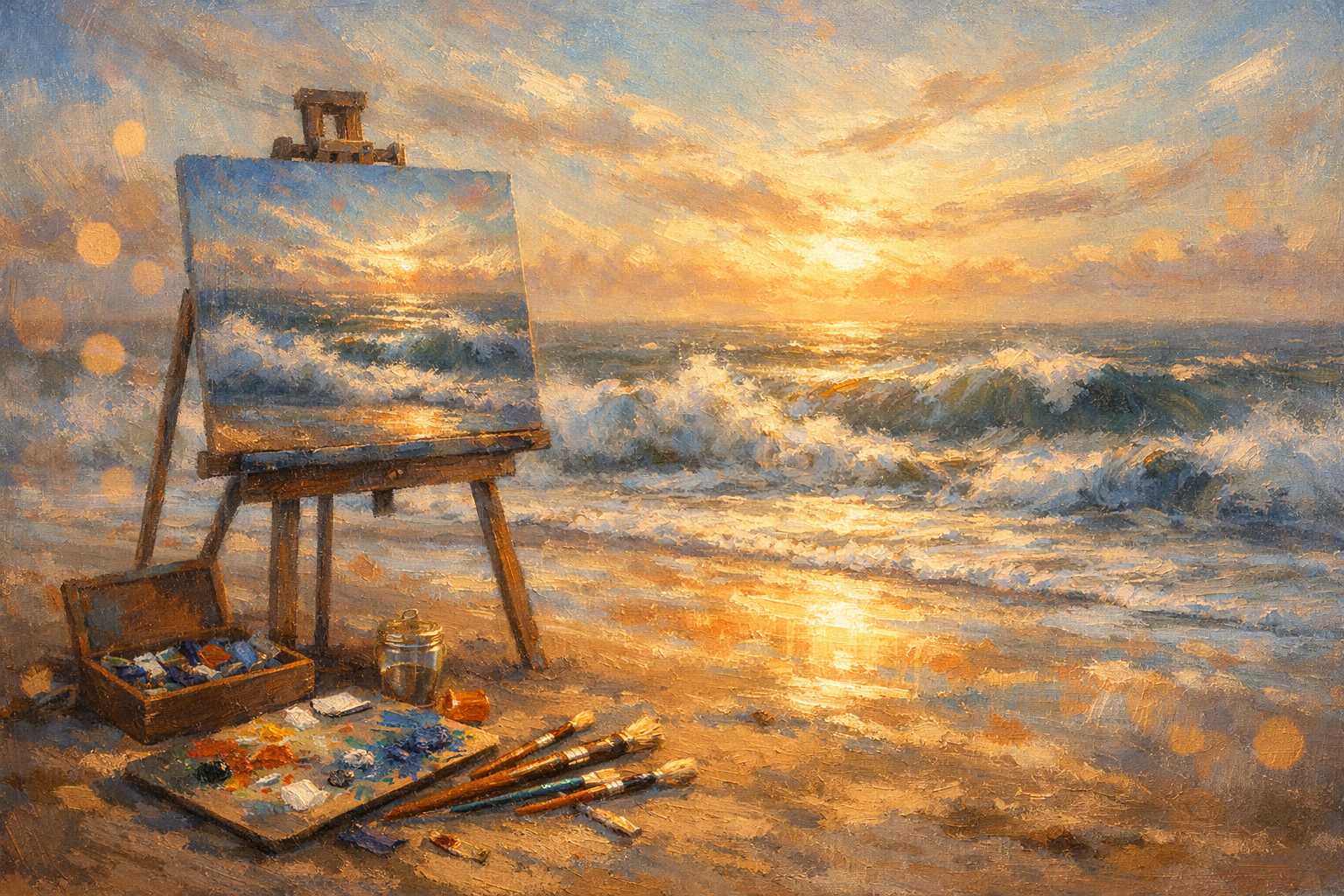
Unveiling the Magic of Coastal Painting: Your Guide to Crafting Impressionist Seascapes
Ever found yourself on a beach, enraptured by the beauty and yearning to immortalize the moment? Coastal painting is your ticket into a realm of infinite artistic possibilities. The shifting light, undulating waves and picturesque skies offer perfect subjects for any impressionist technique.
Embark with us on a fantastic journey in the world of seascape painting!
Embarking on the Adventure of Coastal Painting
No need to feel daunted about coastal painting. Initiate at a basic level and escalate your confidence level gradually.
Start with elementary shapes. Envision waves as dynamic curves rather than intricate details. Visualize rocks as plain geometric figures. Consider clouds to be amorphous masses floating gently across your canvas.
The secret lies in keen observation. Invest time in understanding the dynamics of water. Pay attention to the interplay of light on cresting waves. Observe how colors metamorphose throughout the day.
The Essentials for Crafting Seascape Masterpieces
You don't need to invest heavily on supplies initially. A few high-quality basics will prove to be ample.
Brushes: - Flat brushes: Ideal for a sweeping stroke
-
Round brushes: Perfect for adding detailed textures
-
Fan brushes: Essential for creating textural effects
Colors: - Ultramarine Blue
-
Cerulean Blue
-
Titanium White
-
Raw Umber
-
Yellow Ochre
-
Cadmium Yellow
Canvas: Choose medium-grained canvas boards or stretched canvases. They possess exceptional paint retention capacity and aid in exquisite texture creation.
Mastering the Art of Light and Atmosphere
Light, the artist's best friend or worst enemy, has the power to transmute simple seascapes into magical realms.
Morning light usually casts a cool and soft vibe, while midday sun results in striking contrasts and bright highlights. Evening encompasses everything in warm and golden hues.
Atmosphere adds profundity to your paintings. Objects situated at a distance appear faded and lack detail, while nearby objects manifest more contrast and sharp edges.
Try painting the same scene at different time intervals. You will find the changing mood mesmerizing!
The Technique of Color Mixing for Oceanic Imagery
Depicting water is not just about using shades of blue. Recreating a convincing aquatic foreground requires reflecting the surrounding environment colors.
Shallow water usually displays a turquoise or a greenish hue. You can achieve it by mixing a pinch of yellow or white to blue.
Deep water exhibits a darker and more prominent shade. Combine ultramarine blue with a hint of raw umber for this effect.
Foam and waves don't appear pure white. Add a touch of blue, yellow or gray to devise authentic foam tones.
Remember: Transparency is a quintessential characteristic of water. It reveals what lies beneath and reflects what is above.
Rendering Movement in Water
The incessant motion of water poses both opportunities and challenges for artists.
Paint calm water with horizontal brushstrokes, providing a suggestion of the water surface extending towards the horizon.
For waves, conform to their natural curves with your brush. Begin with basic shapes and then enhance with details like foam and spray.
Steer clear from overdoing wave details. Often, a simple brushstroke succeeds more in encapsulating movement than meticulous detail work.
Recreating Dramatic Skies
Skies frequently dictate the mood of coastal scenes.
Clear skies: gradate from a darker blue at the zenith to a lighter shade near the horizon.
Cloudy skies: Use the wet-on-wet technique for softer, natural cloud edges. Leave some areas raw and unspecified.
Stormy skies: Use darker hues and assertive contrasts. Don't hesitate to introduce dramatic lighting effects.
Make sure to paint quickly enough to avoid your paint drying up. A swift brushstroke helps achieve naturally looking cloud formations.
Compositional Tips for Crafting Magnetic Seascapes
A well-composed painting draws the viewer's eye through the artwork, creating an engaging flow and intrigue.
Rule of thirds: Set your horizon line either one-third above or below from the edge of your canvas.
Leading lines: Employ wave patterns, shorelines, or cloud trails to guide attention towards focal points.
Foreground interest: Incorporate rocks, driftwood, or beach minutiae to develop depth and perspective.
Avoid centralizing everything. Choose to place points of interest off-center for more organic and dynamic compositions.
Working Magic with Wet Sand and Reflections
Wet sand lends a lovely mirror-like quality to beaches. These reflections give your coastal paintings an instant visual charm.
Depict wet sand a tad darker than dry sand along with horizontal brushstrokes to suggest its flat and smooth surface.
For reflections, use vertical brushstrokes drawn downwards. Make the reflections slightly duller and less detailed than the elements they reflect.
Ensure the edges of reflections are soft. Sharper edges against watery surfaces and wet areas tend to look unnatural.
Integrating Texture and Details
Texture breathes life and provides a tactile dimension to your coastal paintings, invoking the sensation of feeling the coastal breeze.
Sand texture: Employ a dry brush or palette knife application, adjusting the pressure for different types of sand.
Rock texture: Utilize broken brushstrokes and diversify colors to indicate effects of weathering and erosion.
Wave texture: Employ the edge of a palette knife to cut through wet paint, simulating realistic foam patterns.
Add details incrementally and frequently step back to examine their impact on the overall painting.
Common Pitfalls to Avoid
Every artist slips sometimes, That's a part of the creative journey. Recognizing and learning from mistakes speeds up your artistic evolution.
Overworking: Excessive detail can eradicate the essential freshness and spontaneity that characterizes an impressionist painting.
Proportional errors: Ensure your waves look convincing in size in relation to other elements.
Muddy color palette: Make sure to clean your brush after painting with each color. Muddy color mixtures compromise the vibrancy that defines coastal scenes.
Rigid brushwork: Loosen up! Impressionist techniques flourish best with bold, fluid brushstrokes.
Experiencing Plein Air Painting
Painting in open air instills a sense of immediacy in your coastal scenes. The mutable light impels you to work faster and emphasizes the need to focus on fundamental elements.
Preparation tips: - Get to the location early to choose your most inspiring spot - Bring a lightweight easel for easy transportation - Limit the colors in your palette - Don’t forget to wear sun protection
Working promptly: - Establish major shapes first - Emphasize capturing the light effect instantly - Later elaboration with details can be done in the studio if necessary
Remember that weather near the coast can change rapidly. So, stay prepared for quick adaptations or a swift pack-up if needed!
Cultivating Your Unique Style
Every artist gradually develops a distinct style. Take your time in this process.
Learn from other impressionist artists. Understand their interpretation of similar subjects, their color choices, and brushwork.
Explore diverse techniques. One day, experiment with vigorous, dynamic brushstrokes while the next, try softer, more gentle strokes.
Maintain a painting journal. Document what works and what doesn't. Monitor your progress over time.
Above everything, paint subjects that ignite your passion. The energy shows in the final product.
Building a Consistent Coastal Painting Practice
Consistency outperforms occasional intensity when it comes to developing painting skills. Regular, even short practice sessions yield better results than infrequent marathon painting sessions.
Establish a simple workspace at home. A small table by a window would suffice for practicing and color mixing.
Use photographs for practice when you can't visit the coast. Even though less than ideal, photographs provide an opportunity to practice techniques and experiment with novel ideas.
Participate in local art groups or online communities. Sharing your work and receiving critiques helps speed up your learning.
Concluding Thoughts on Coastal Painting
Coastal scene painting offers infinite inspiration and opportunities for artistic expression. Each visit to the coast uncovers new lighting conditions, weather patterns, and facets of natural beauty.
Remember, every great artist was once a novice. Be patient with yourself and celebrate your small victories while learning from challenges.
The most crucial step is just to begin. So, grab your brushes, head to the nearest beach, and initiate your painting. Your artistic adventure is awaiting!
The mesmerizing ocean has been enticing artists for ages. It's now your turn to ensnare its enchantment on your canvas.